

Just above the Western Islands of Amsterdam you will find the Oude Houthaven. Wood from Scandinavia used to be stored and processed here (for the construction of ships and houses). There are large warehouses on Van Diemenstraat. Unique office spaces are available for rent here, offering a view of the old Houthaven at the rear.

At the end of the 19th century, the city was also expanded on the west side, and the Van Diemenstraat was built on the dike that formed the bank of the Houthavens. Above you see a painting by Breitner, depicting the piling work in 1897 for the warehouses that still stand in Van Diemenstraat. The cozy Zeeheldenbuurt was created between the so-called Zandhoek and the van Diemenkade, where you can still find brown bars.
History of the Zeeheldenbuurt
The first buildings in this area date from the 17th century and consisted mainly of shipyards, railway lines and taverns until well into the 18th century. There were mainly workshops and a few company houses here, with warehouses on the Zoutkeetsgracht. The first salt chains appeared here around 1615, soon followed by others — seawater was heated here over peat fires in large pans to extract the salt. And in 1652, the area behind the Blaauwhoofd stronghold was assigned to the herring smokers, at Bokkinghangen.
For almost two centuries, little changed here — the salt chain was slowly replaced by homes and warehouses. It was a very busy and bustling neighborhood in the 18th and 19th centuries, but when more and more companies moved elsewhere it became more of a residential area, except for the large warehouses on Van Diemenstraat.

The Petemayen Bridge from Zandhoek to Bokkinghangen.
Photo from 1893 by Jacob Olie (1834-1905) (Amsterdam City Archives).
Van Diemenstraat
Private individuals and companies had large warehouses built on Van Diemenstraat (called Barentszkade before 1878). The Deli Company built a group of six warehouses in 1917. These warehouses were supplied from ships via the back (on the Van Diemenkade), and at the front (the Van Diemenstraat) there was a railway line to further transport the goods.
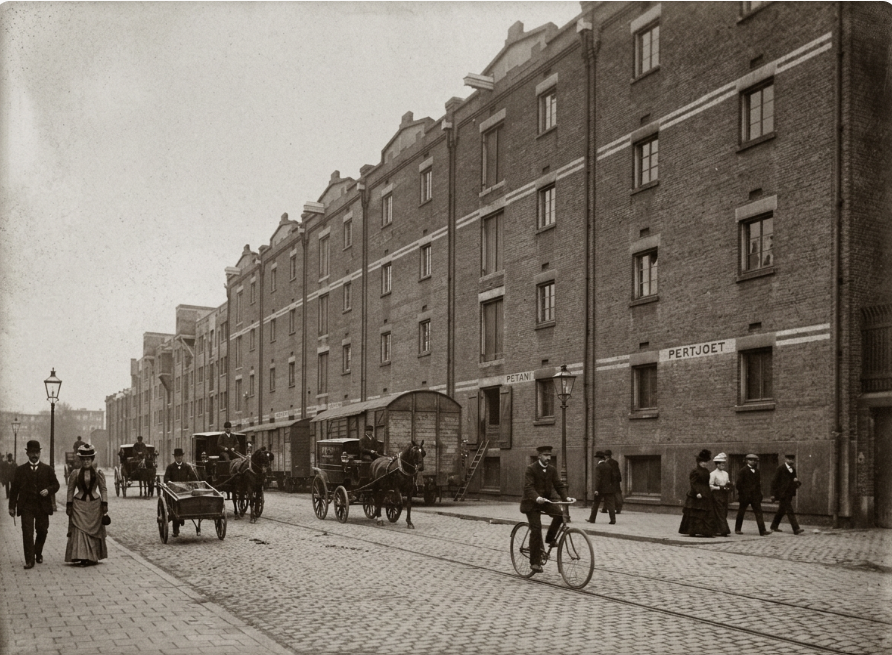
The Deli Company, founded in 1869, grew into the cultivation and trade of tobacco, especially from Sumatra. The six parts of the building were named after places on Sumatra: from left to right Wampoe, Begoenit, Nintjirim, Belawan, Petani and Pertjoet. The names are still visible at the back of the building.
The old warehouse was completely renovated in 2020 by the renowned architectural firm Cruz y Ortiz (the firm that was also responsible for the renovation of the Rijksmuseum).